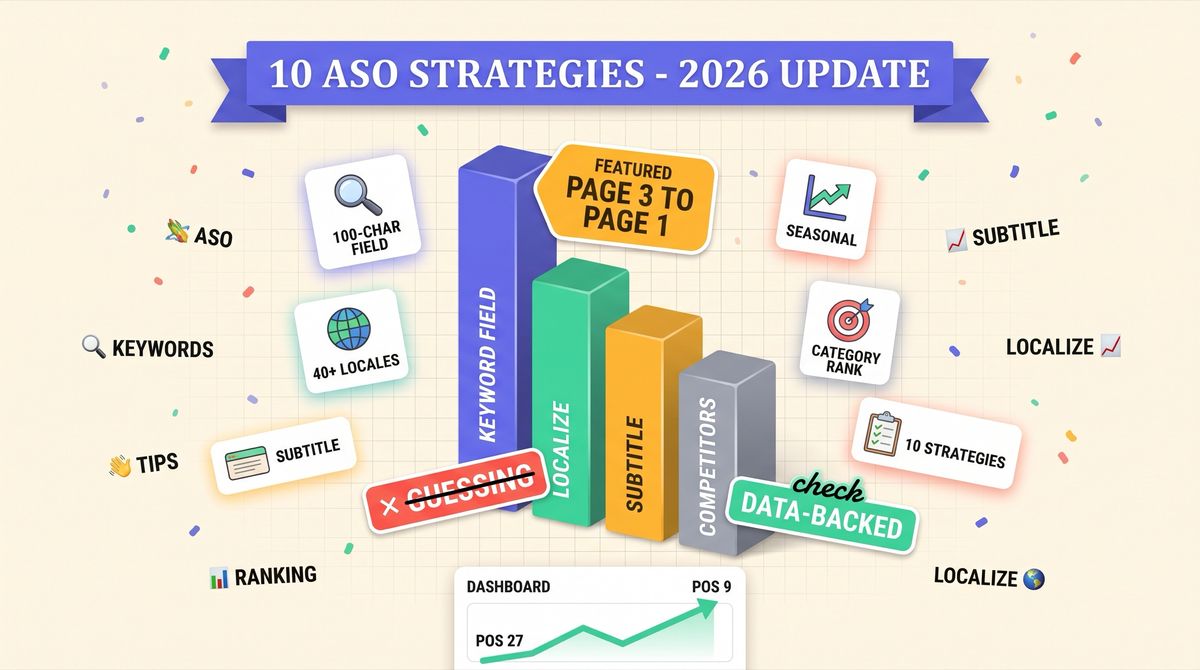
ASO keyword optimization means matching your app's title, subtitle, keyword field, and localized listings to the exact terms people search for on each store, then rechecking that mapping every quarter as competitors shift. The highest-leverage move most indie teams skip is not adding more English keywords. It is localizing the keyword field into a second market. Below are 10 concrete strategies, the mistakes that erase most of the gains, and a priority order for a solo developer versus a small team.
Quick ASO Tips
Short on time? Here are the five moves worth doing this week, pulled from the ten strategies below.
- Target 3-4 word long-tail keywords before you chase head terms (strategy 1)
- Fill Apple's 100-character keyword field with singular, non-repeated terms (strategy 2)
- Localize your keyword field for every market you sell in, not just English (strategy 3)
- Check your subtitle and short description against the exact character limits (strategy 6)
- Review keyword difficulty every quarter and shift effort to what is working (strategy 9)
1. Target Long-Tail Keywords First
New and smaller apps cannot compete for head terms like "photo editor" or "fitness tracker." Instead, target long-tail keywords: more specific phrases with lower competition but higher intent. "Photo editor with background remover" has a fraction of the search volume of "photo editor," but the users searching for it know exactly what they want and are more likely to download.
Start with 3-4 word phrases, build ranking authority, and gradually work toward more competitive terms as your app gains traction.
2. Use Apple's 100-Character Keyword Field Strategically
Apple gives you exactly 100 characters for keywords in App Store Connect. Every character counts. Follow these rules:
- Use commas to separate keywords, no spaces after commas
- Never repeat words already in your title or subtitle
- Use singular forms only, since Apple matches both singular and plural
- Skip prepositions (the, a, and, or), which Apple ignores
- Include common misspellings of your competitors' names
3. Localize Your Keywords for Every Market
This is the single most underutilized ASO strategy, because most developers optimize their keyword field in English and skip every other market outright. Apple allows a separate keyword set per localization, and some localizations serve multiple countries: the UK English localization, for instance, also serves Australia and several other English-speaking markets. Use this to target region-specific terms instead of reusing the same list everywhere.
Translated length is not fixed just because the English string fit. Our audit of 41 App Store locales found 19 in a high overflow-risk bucket after translation, with German running 35% longer than English (see the full character-limit breakdown). A keyword string that fits your 100-character budget in English can blow past it once translated, so check the translated field against the limit before you ship it, not after. Run it through our App Store localization checker first. For the revenue case behind doing this work at all, see why localization is the highest-leverage ASO move indie developers skip.
4. Use Google Play's Full-Text Indexing
Unlike Apple, Google Play indexes your full app description for keywords. This means your 4,000-character description is a real keyword opportunity. Write naturally but strategically. Include target keywords 3-5 times each throughout the description without keyword stuffing.
Google's algorithm is sophisticated enough to understand synonyms and related terms. If you target "budget planner," Google will also consider your app for "expense tracker" and "money manager" searches.
5. Analyze Competitor Keywords
Your competitors have already done keyword research for you. Use ASO tools to identify which keywords your top competitors rank for, then find gaps: keywords they rank for weakly or not at all. These gaps are your best opportunities for quick wins.
Pay special attention to competitors who recently improved their rankings. Their keyword changes can reveal emerging search trends before those trends become competitive.
6. Optimize Your Subtitle (Apple) and Short Description (Google)
These fields carry real keyword weight on both platforms. Your Apple subtitle (30 characters) and Google Play short description (80 characters) should balance keyword optimization with compelling messaging.
A/B test different versions to find the balance between discoverability and conversion. A subtitle that ranks well but sounds robotic will hurt your conversion rate.
Both limits are exact and both stores cut the field at the character, not the word. Draft a few versions and check each one against our App Store character limit reference before you submit, so you are not guessing where the cutoff lands.
7. Update Keywords Seasonally
Search behavior changes throughout the year. Fitness apps see large keyword volume shifts in January. Shopping apps peak during holiday seasons. Tax apps spike in spring. Align your keyword strategy with these seasonal patterns.
Set a calendar reminder to review and update keywords at least quarterly. Even non-seasonal apps benefit from fresh keyword analysis as search trends evolve.
8. Use Category Rankings as a Keyword Signal
Your app's category affects how both stores interpret your keywords. An app in the "Productivity" category with the keyword "notes" gets treated differently than a "Music" app with the same keyword. Choose your primary and secondary categories to reinforce your target keyword themes.
9. Monitor and React to Keyword Difficulty
Keyword difficulty is not static. It changes as competitors enter and leave the market. A keyword that was easy to rank for six months ago might now be dominated by well-funded competitors. Keywords abandoned by competitors become easier to capture.
Track your keyword difficulty scores weekly and be prepared to pivot. The fastest way to improve visibility is to find and dominate low-difficulty, medium-volume keywords before your competitors do.
10. Combine ASO With Paid Search Intelligence
If you run Apple Search Ads or Google App campaigns, use the search term reports to discover real user queries you might be missing in your organic keyword strategy. Search ads data reveals exactly what users type, including variations and phrases you would never think of on your own.
Feed these discoveries back into your organic keyword strategy. Paid and organic work as complementary channels, each informing the other.
App Store vs Google Play Keyword Mechanics
Strategies 2 and 4 above work because the two stores index keywords in different places. This table lays out the mechanical difference that drives which tactic applies where.
| Field | App Store (iOS) | Google Play |
|---|---|---|
| Where keywords live | Hidden 100-char keyword field | Full 4,000-char description |
| User-visible? | No, backend only | Yes, part of the listing |
| Plural handling | Singular auto-matches plural | Understands synonyms |
| Edit tied to a release? | Yes, ships with the version | No, editable anytime |
Because Google Play ties keywords to visible copy, a description rewrite doubles as a conversion test. An App Store keyword field change is invisible to shoppers and only affects ranking, so you can test it more freely without touching the public listing.
ASO Strategy Priorities by Team Size
Not every strategy above deserves equal time in week one. A solo developer and a small team should work through this list differently, using the same effort-versus-impact reasoning in our breakdown of cost-effective ASO tools for indie developers.
| Strategy cluster | Solo dev | Small team |
|---|---|---|
| Keyword field + long-tail (1, 2) | Do first | Do first |
| Localize keywords (3) | Top 2 markets | Top 5 markets |
| Competitor gaps (5) | After week 1 | Do first |
| Seasonal review (7) | Calendar reminder | Assign an owner |
| Paid search intel (10) | Skip until ads run | Run alongside ads |
The pattern holds at both sizes. Keyword field and long-tail targeting come first because they cost time, not budget. Localization and competitor tracking pay off faster with more hands, so a solo developer should scope them down instead of skipping them.
Common ASO Keyword Mistakes
Most of the ranking loss we see comes from a handful of repeated errors, not a missing advanced tactic.
- Repeating title words in the keyword field. Apple already indexes your title and subtitle. A repeated word wastes a slot you could spend on a new term.
- Using plural forms. Apple matches singular and plural from a single entry. Two forms of the same word is one wasted slot.
- Leaving old keywords in after a pivot. A keyword field written for last year's positioning pulls in the wrong searchers, and that drags down conversion and then ranking.
- Skipping localization past English. Strategy 3 covers why. It is the mistake with the largest gap between effort and payoff.
- Guessing at character limits. A truncated subtitle or short description reads as unfinished to a user deciding whether to tap in. Check the exact limit before you write, not after.
ASO Keyword Field Budget After Translation
The best ASO strategies for the keyword field fall apart if you plan the 100-character budget against English alone. A translated keyword list does not carry the same term count as the source, because most languages run a different length than English for the same meaning. We measured this per locale for app name and subtitle fields in our character-limit overflow audit, and the same expansion ratios apply to the comma-separated keyword field: more characters per term in German, fewer in Chinese.
| Locale | Length vs English | Term budget out of 100 chars |
|---|---|---|
| German (de-DE) | +35% | ~74 English-equivalent chars |
| Finnish (fi) | +30% | ~77 English-equivalent chars |
| Arabic (ar-SA) | +25% | ~80 English-equivalent chars |
| Japanese (ja) | -45% | ~182 English-equivalent chars |
| Chinese, Simplified (zh-Hans) | -50% | ~200 English-equivalent chars |
Plan the German and Finnish keyword lists first and let the rest fit, not the other way around. If your English list fills all 100 characters, the German translation of that same list needs roughly 135 characters worth of terms to say the same thing, which does not fit. Drop one or two lower-priority terms from the English list before translation, rather than discovering the overflow after the vendor delivers.
Putting It All Together
ASO keyword optimization is an ongoing process. Apps that rank well test, measure, and adapt based on real performance data instead of setting keywords once at launch and moving on. Start with the Quick ASO Tips list above, work through the strategy priorities for your team size, and revisit your keyword difficulty scores every quarter.
For the tools that make steps 2, 5, and 9 faster to run in practice, see our comparison of the best ASO keyword research tools.
FAQ
What is ASO keyword optimization?
It is the process of matching your app's title, subtitle, keyword field, and description to the terms people actually search for on the App Store and Google Play, then reviewing that match on a schedule as competitors and search trends shift.
How many keywords should I target on the App Store?
There is no fixed count. Apple's keyword field gives you 100 characters, which typically fits 15-25 comma-separated terms depending on word length. Fill it with singular, non-repeated terms rather than aiming for a specific number.
Does Google Play index my app description for keywords?
Yes. Unlike Apple, Google Play indexes the full 4,000-character description, so keyword placement in the body copy matters on Google Play in a way it does not on the App Store.
How often should I update my ASO keyword strategy?
Review keyword difficulty and seasonal shifts at least quarterly. A keyword field written for last year's positioning is one of the most common sources of ranking loss we see, and it costs nothing to check.
What ASO strategies should I prioritize first?
Keyword field and long-tail targeting first, because they cost time instead of budget. Localizing that same keyword field into your top two or three markets is second, and it is the strategy most solo developers skip entirely. Competitor gap analysis and seasonal review come after those two are in place, not before.