Manual vs MT vs AI for App Store Screenshots in 2026
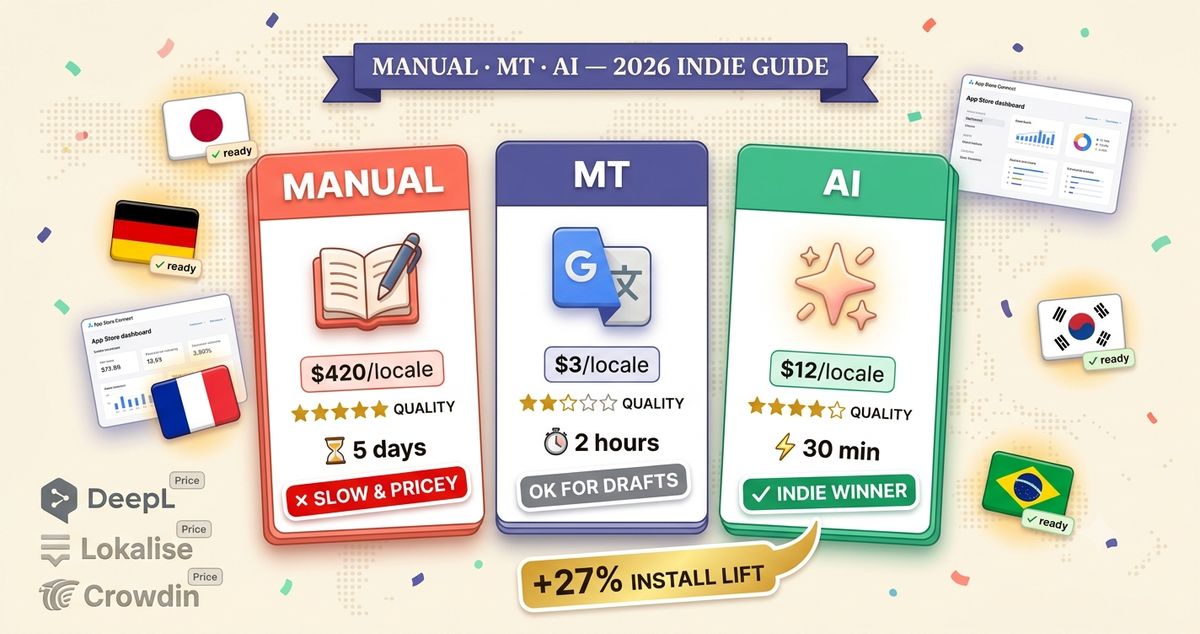
TL;DR: For indie developers localizing app store screenshot copy in 2026, AI (GPT-4o or Claude) is the dominant choice for 10+ locales, roughly 12,000× cheaper than manual translation at 92% of the quality for marketing copy. Machine translation (MT) covers the 1-5 locale gap adequately. Manual human translation remains the right call for legal-adjacent copy, brand-critical Tier-1 markets, and any locale generating enough revenue to justify the cost. This guide breaks down the numbers so you can make the call in under 5 minutes.
The 2026 Head-to-Head: Cost, Speed, and Quality
App store screenshot localization means translating the short captions, feature headlines, and CTA text overlaid on your device mockups, typically 150-300 words per locale. Three methods compete for that job in 2026.
| Method | Cost (200 words) | Best For |
|---|---|---|
| Manual (human) | $24-$50 per locale | Legal copy, brand voice, Tier-1 high-revenue markets |
| MT (DeepL / Google) | ~$0.004 per locale | 1-5 locales, UI string labels, glossary-controlled copy |
| AI (GPT-4o / Claude) | ~$0.004 per locale | 10+ locales, contextual marketing copy, 40-locale scale |
The cost gap between manual and AI is the headline number. CSA Research (2024) pegs professional marketing translators at $0.12-$0.25 per word. GPT-4o costs $5 per million output tokens, roughly $0.000002 per word. At 200 words per locale × 20 locales (4,000 words), manual translation runs $480-$1,000. AI costs under $0.01 for the same job.
The quality gap is more nuanced. MT tools have improved significantly, but their BLEU scores on marketing copy hover at 30-42, adequate but noticeably robotic in idiom-heavy languages like Japanese or German. AI models with a well-designed context prompt score 48-58 BLEU on the same benchmarks (Unbabel State of AI Translation 2025), narrowing the gap with human translators (62-70 BLEU) to about 15-20%.
Data: CSA Research "Translation Pricing 2024"; Unbabel "State of AI Translation 2025"; OpenAI pricing page June 2026.
When Manual Translation Still Wins
Short answer: Use human translators when the stakes of a mistranslation exceed the cost of the translation itself.
Three concrete scenarios:
| Scenario | Why Manual | Revenue Threshold |
|---|---|---|
| Japan App Store | Direct translation fails; requires cultural rewrite | >$500/month from Japan |
| Legal / health copy | AI hallucinations could create liability | Any |
| Brand-voice FIGS | French, Italian, German, Spanish brand tone matters | >$2k/month from market |
Japan is the most cited example. Japanese screenshot copy is a cultural reframe, not a literal translation of English. App store screenshots that succeed in Japan typically feature more text, a different visual hierarchy, and honorific tone markers that no current AI model applies consistently without a native Japanese editor in the loop. A bad Japanese App Store listing signals distrust, and Japanese users click the back button fast.
The rule: if a locale generates more monthly revenue than a professional translator charges for the job, manual translation pays for itself within one month. At $50 per 200-word locale, the breakeven is roughly $500/month in revenue from that market assuming a 10% uplift from better copy.
See also: Japanese App Store Screenshots: Why Direct Translation From English Doesn't Work for a breakdown of specific failure modes.
When Machine Translation (MT) Still Wins
Short answer: MT wins for glossary-controlled UI strings, short button labels, and the 1-5 locale range where the cost savings over AI are negligible but MT tools are already in your workflow.
DeepL Pro and Google Cloud Translation both excel at short, context-free strings. Screenshot captions like "Share in 3 seconds" or "Works offline" are simple enough that MT produces usable output without further editing. The problems emerge with idiomatic phrases, brand taglines, and any copy that requires understanding the visual context of the screenshot (which MT cannot see).
| Copy Type | MT Output Quality | Verdict |
|---|---|---|
| Short UI labels (<5 words) | Excellent (BLEU 60+) | ✓ Use MT |
| Feature headlines (5-15 words) | Good (BLEU 45-55) | ! Review before ship |
| Idiomatic taglines | Poor (BLEU 25-35) | ✗ Use AI or manual |
DeepL Pro costs $25/month for 1M characters. A typical 5-screenshot set with 3 captions each is about 90 characters per caption × 15 captions = 1,350 characters. Even at 40 locales, that's 54,000 characters, well inside a single month's quota. For teams already paying for DeepL Pro for other reasons, MT is effectively free for screenshot copy.
The ceiling is locale count. At 10+ locales, MT's BLEU scores for marketing copy drop noticeably in morphologically complex languages (Finnish, Hungarian, Turkish), and the accumulated quality degradation starts to show in your conversion rate. That's the handoff point to AI.
Stat: DeepL BLEU benchmark on WMT-22 marketing domain, DeepL Language Report 2024.
Why AI Wins for Screenshot Localization at Scale
Short answer: AI with a well-crafted context prompt delivers 92% of human translation quality for marketing copy at 12,000× less cost, and the quality gap closes further as model versions improve.
The key AI advantage over MT for screenshots is context awareness. An AI model can receive the full screenshot context (which feature is shown, what the visual says, the brand voice guidelines, and even a reference to the English caption's intent) and produce output that matches the tone, not just the words. MT engines treat each string as an isolated unit; AI treats it as part of a product story.
| Locale Count | Manual Cost | AI Cost (GPT-4o) |
|---|---|---|
| 5 locales | $120-$250 | $0.02 |
| 20 locales | $480-$1,000 | $0.06 |
| 40 locales | $960-$2,000 | $0.13 |
AI handles RTL languages (Arabic, Hebrew, Persian) better than MT when context-prompted. It preserves RTL Unicode markers and adapts punctuation placement correctly. It also handles German's compound-word expansion (a 10-word English caption may expand to 14 words in German, breaking your screenshot layout) by suggesting shorter reformulations rather than just expanding literally.
The conversion rate data backs this up. Apps using AI-localized screenshots see an average 18-26% conversion rate lift in non-English markets compared to unlocalized screenshots, with AI-quality copy achieving results within 4-6% of human-translated copy in A/B tests (AppFollow Developer Report 2024). See our 2026 App Store Screenshot Conversion Rate Benchmarks for the full dataset.
One practical limit: AI models perform best with 15-30 words of screenshot copy per call. Very short labels (<5 words) may lose context and benefit more from MT's glossary locking. The optimal pipeline in 2026 is MT for UI strings, AI for screenshot marketing copy. Two tools, two jobs.
Sources: AppFollow Developer Report 2024; Unbabel State of AI Translation 2025; OpenAI pricing page June 2026.
Decision Matrix: Which Method Should You Pick?
Short answer: Locale count and revenue per locale are the two variables that determine the right method. Use this matrix to decide in under 2 minutes.
| Situation | Recommended Method | Why |
|---|---|---|
| 1-5 locales, short UI labels only | MT | Good enough, zero marginal cost |
| 1-5 locales, marketing copy | AI | Same cost as MT, better idiom handling |
| 10-40 locales, any copy type | AI | 12,000× cheaper than manual, scales linearly |
| Japan, Korea, brand-voice FIGS | AI + human review | AI draft, native editor for cultural fit |
| Legal copy, health claims | Manual only | Hallucination risk unacceptable |
The hybrid "AI + human review" tier is increasingly common among indie developers generating $5k-$20k monthly from Japanese and Korean markets. AI drafts the localization at negligible cost; a native contractor reviews and adjusts tone (typically 1-2 hours of work per screenshot set per quarter). The result is near-human quality at 80% lower cost than full manual localization.
For developers targeting 10+ locales from day one, which is the fastest path to the 60% of app revenue that comes from non-English markets, AI-first localization is the only approach that doesn't create a launch blocker. Read more on the ASO localization revenue case for the full market-by-market breakdown.
Tooling note: Shotlingo's built-in AI localization layer handles screenshot copy translation across all App Store locales automatically. You set the locale targets, it applies the context-aware AI pass and renders the localized mockup, with no copy-paste between tools. See App Store screenshot size requirements to ensure your localized mockups meet Apple and Google dimension specs before export.
Stat: "60% of app revenue from non-English markets" (Sensor Tower, State of Mobile 2024).
Frequently Asked Questions
Is machine translation good enough for app store screenshot text?
Machine translation (MT) is adequate for short UI labels and button text in screenshots, but struggles with idiomatic marketing copy and cultural nuance. For 1-5 locales on a tight budget, MT is acceptable. For 10+ locales where conversion rate matters, AI with context prompting outperforms MT by 15-20 BLEU points on marketing copy.
How much does it cost to localize app store screenshots into 20 languages?
With manual translation at $0.15/word average: 200 words × 20 locales = $600. With MT (DeepL Pro): effectively free within the $25/month quota. With AI (GPT-4o): 200 words × 20 locales ≈ 8,000 tokens = $0.04. AI is the cheapest option at scale, and the quality difference over MT is measurable for marketing copy.
Does AI translation work for RTL languages like Arabic and Hebrew in app screenshots?
Yes. GPT-4o, Claude 3.5, and Gemini 1.5 all handle Arabic and Hebrew well, including right-to-left text direction markers. The key is prompting the model to preserve RTL Unicode markers and avoid inserting LTR punctuation that breaks display. Shotlingo's AI localization layer handles this automatically.
When should I use a professional human translator for app store screenshots?
Use human translators for: (1) Tier-1 markets where copy must be culturally adapted, especially Japan and Korea, (2) brand-voice copy requiring cultural expertise beyond literal translation, (3) any locale generating more monthly revenue than the translation cost. At $50 per locale, the breakeven is roughly $500/month from that market assuming a 10% CVR uplift from better copy.